PAGE NAVIGATION
The Capture Plan Process
The process of managing and engaging in the pre-competition phase in an organized way that is designed to increase win potential.
1. Populate
- Populate capture plan with known information
- Identify the holes and areas with information gaps and set forth action items to gain that knowledge
- Maintain client focus and perspective throughout process

2. Validate
- Use multiple sources for client and competitor information
- Confirm agreement and support for internal information and decisions

3. Update
- Use capture plan to develop action items
- Seek information to fill gaps
- Add new information as it becomes available and update outdated intel
- Continue to build action plans that improve positioning

4. Implement
- Track progress of action items
- Maintain team communication and develop a win strategy
What is the process?
Imagine a capture plan as a framework, a series of folders or buckets, where you assemble and POPULATE data by topic. The process is formalized, yet flexible since all opportunities are different and require varying levels of effort. The capture plan process leads us to ask certain questions, VALIDATE known information, and identify information gaps. As we work through the process, we research unknowns, document and UPDATE our intel, and IMPLEMENT action plans to refine our knowledge. Capture plans are living documents that are repeatedly updated as you gain information.
Why capture plan?
We capture plan to win more, make smarter go/no-go pursuit vetting decisions, and make best use of Garney resources. Our goal is to develop an understanding of the client’s project-specific wants and needs and then formulate a plan, team, and solution to best meet those needs.
We develop specific action plans to build relationships with clients in order to gain insight on their goals for a project. As we gain understanding of the project and expected proposal requirements, we are able to streamline work internally once an RFQ or RFP is issued. The process can also allow Garney to realize if the opportunity is better aligned for our competition and we should no-go an opportunity.
Benefits of Capture Planning
- Win more frequently by developing a plan or "win strategy"
- Create action plans that build trust and relationships with clients to improve positioning
- Knowledge source – Share information between Operations, Business Development, and Marketing
- Identify gaps in win strategy and capabilities and take action to improve
- Save money and reduce wasted resources
- Make better go/no-go decisions
- Head start on proposal and presentation
Team Roles & Responsibilites
Use the right skills
Capture plan team members’ skills must be suited to their assigned action, whether direct customer contact, internal development, or assisting the proposal team with technical deliverables. Leverage the different strengths and capabilities of your capture plan team to make effective action plans with reasonable deadlines.
Expectations
Capture planning is interactive and always takes place in a group meeting. Capture planning should be led by an OPL and supported by the Profit Center, Marketing Lead, Operations Staff, and outside teaming partners depending on the size and scope of the pursuit.
Key responsibilities by role
- Drive Process/ Project Champion
- Build Client Relationships
- Win Strategy Development
- Facilitates Meetings and Calls
- Resource Allocation
- Risk Assessment
- Build Client Relationships
- Support OPL
- Marketing assistance and deliverables
- Build Client Relationships
- Win Strategy Development through Technical Tasks
- Varies – Depending on Role and Client Relationship
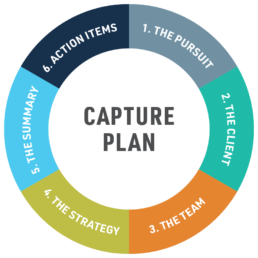
Steps to the capture plan
There are six general steps to the capture plan listed below that focus on identifying specific objectives related to the opportunity. The tools used to assist with these steps, the individuals involved in each step, and other details are outlined in the following pages.
Pursuit overview, description, and scope; key challenges & issues
TOOLS:
PURSUIT VETTING FORM (GO/NO-GO)
Key issues & influences; client relationships
TOOLS:
CAPTURE PLAN (TYPICAL)
CLIENT PLAYERS SHEET (FOR MORE DETAILED ANALYSIS)
Organizational chart; teaming partners; qualifications/experience
TOOLS:
ORGANIZATIONAL CHART
TEAM EXPERIENCE MATRIX
Competitor analysis; Teaming partner analysis; SWOT analysis; “Issue-Feature-Benefit-Proof”; anticipated selection criteria
TOOLS:
Capture Plan
SWOT Analysis
Win Theme Development: Issue, Feature, Benefit, and Proof Formula
Identify discriminators/differentiators; Win Theme development; identify information gaps and opportunities for action
TOOLS:
Win Strategy Development
Action Items
Pursuit overview, description, and scope; key challenges & issues
TOOLS:
Action Items