
Garney versus the competition
An important aspect of capture planning involves COMPETITION ANALYSIS, which involves identifying potential competitors who may be chasing an opportunity and identifying who might be on their teams. Knowing this information, we can begin to analyze our competition’s strengths and weaknesses to formulate our pre-proposal strategies. SWOT Analysis is a simple but useful framework for analyzing both Garney’s and our competition’s strengths, weaknesses, opportunities, and threats. It helps our positioning by building on what we do well, and addressing what we’re lacking.
Once we have this analysis complete, we can determine how Garney’s team compares to each competitor. We can look at each competitor’s weaknesses and see if our team has any strengths that counter those and also if our competitors have strengths where we have weakness.
It’s important to note that when an RFP advertises, there is typically a code of silence, meaning we are no longer allowed to contact the Client. Because we are in the pre-proposal phase, we can develop action plans geared towards turning our weaknesses into strengths and some of these action plans may include interaction and/or relationship building with the Client. In other cases, we can overcome weaknesses by adding a specialty subconsultant to add qualifications or a “local presence” that our team may be missing.
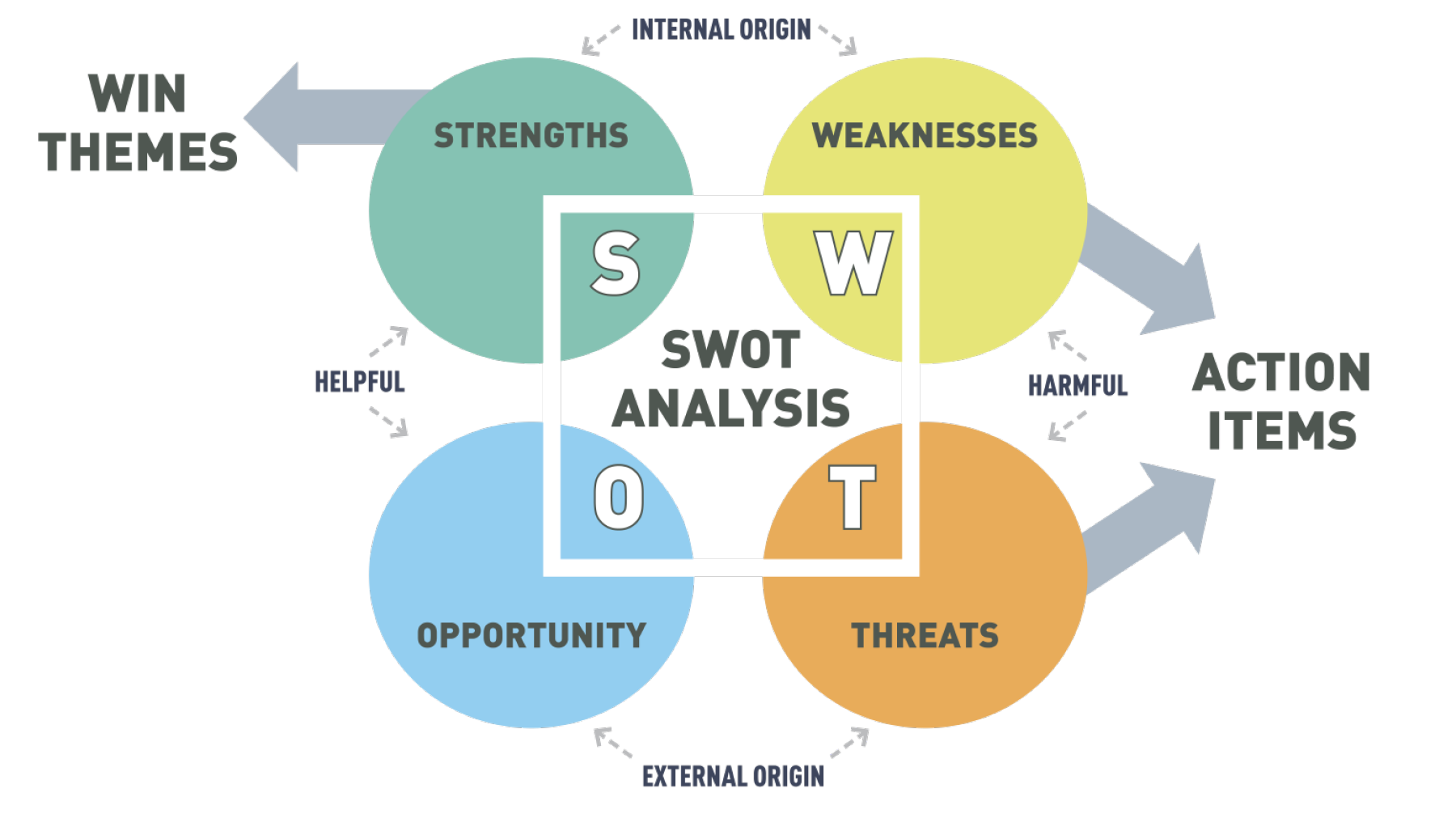
Strengths
Internal OriginHelpful
- Specialty Capabilities
- Competitive Advantages, i.e. incumbent
- Strong Portfolio with client
- Unique Selling Points
- Client Experienced Staff Resources
- Innovation in Similar Scope of Work
- Location to Site / Locality
- Accreditations, Qualifications, Certifications
- Price, Value, Quality
Weaknesses
Internal OriginHarmful
- Gaps in Capabilities
- Competitive Disadvantages
- No Portfolio with client
- Lack of Competitive Strength
- No Local Office
- No Prior Work in Location and/or Industry
- No Local State Registration; Lacking Accreditations, Certifications, Registrations
- Rates Too High
- Availability Too Low
Opportunity
External OriginHelpful
- Market Development
- Competitor Vulnerabilities
- Technology / Software Development and Innovation, i.e. Builder, BIM, Hololens
- New Markets, Vertical, Horizontal
- Information and Research
- Partnerships
- Agencies
- Volumes, Productions, Economics
- Seasonal, Weather Influences
Threats
External OriginHarmful
- Political / Funding Effects
- Legislative Effects
- Environmental Effects
- IT Developments
- Competitor Intentions
- New Technologies, Services
- Sustaining Internal Resource Capabilities
- Insurmountable Weaknesses
What is the story we are telling?
A good proposal tells a compelling story, and to tell a compelling story you must have a strong Win Theme. A Win Theme helps selection committee members understand why they prefer your company and your solution over the competition. Our Win Theme should align with the overall goals of the client and be supported by qualifications unique to our team, which we call discriminators or differentiators. But how do we develop these differentiators?
We develop differentiators as part of capture planning through the Issue – Feature – Benefit – Proof framework. This brainstorming activity should involve the OPL and Marketing Lead at a minimum, and is beneficial to include other Operations Staff, Profit Center, or outside teaming partners to maximize contributions.
IDENTIFY THE ISSUE: Compelling proposal Win Themes are customer-focused and address a problem for the client, owner, user, community, or operators. This problem is a situation that presents difficulty, uncertainty, or perplexity. That “problem” may or may not be mentioned in the RFP, and is referred to as the issue.
RESOLVE THE ISSUE: For each issue, there is a corresponding feature. The feature is the solution to the problem. The feature is what our team is proposing and/or able to provide to alleviate the client’s problem.
AFFIRM THE BENEFIT: For each solution to a client’s problem, we should recognize the benefit of that solution. How does a Garney-specific feature improve your client’s problem? Does it save them time or money, reduce risk, or enhance quality or safety?
PROVE IT: Lastly, we want to offer the client confidence in our team’s ability to solve their problems. By giving previous proofs or project-specific examples of how we have solved similar issues, we validate the client’s opinion that our team is uniquely qualified to solve their issue(s).
Standing out against the competition
As we capture plan and work through the Issue-Feature-Benefit-Proof framework, it is our goal to identify features and benefits that are unique to our team. If we can solve a client’s problem and provide benefits that other teams cannot, then we set ourselves apart from the competition and bring added value, which increases our chances of winning a project.